
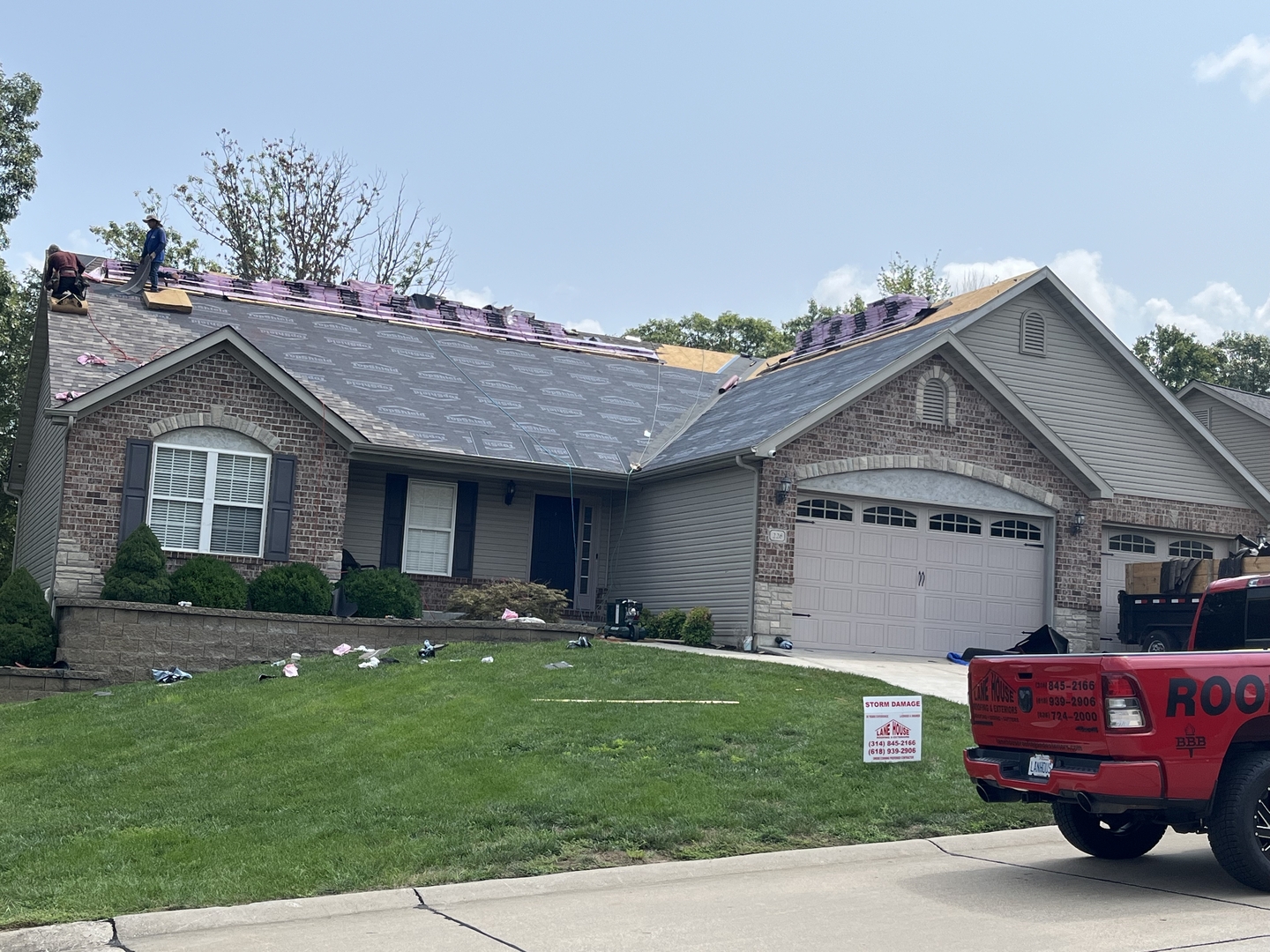
How Long Does a Roof Last? Roof Lifespan by Material in St. Louis
Updated July 29, 2026. Lane House Roofing & Exteriors, 3814 Lemay Ferry Rd, St. Louis, MO 63125. (314) 845-2166.
Direct Answer
A roof in St. Louis typically lasts 18 to 25 years if it uses architectural asphalt shingles, the most common choice locally. Older 3-tab shingles reach 12 to 18 years, standing seam metal 40 to 60. Those figures run below national averages because of hail, freeze-thaw cycling, and heat.
TL;DR
- Architectural asphalt shingles last 18 to 25 years in St. Louis, 3-tab shingles 12 to 18 years, and standing seam metal 40 to 60 years.
- Nearly every material underperforms its national range here by 15 to 25 percent, driven by hail, roughly 60 freeze-thaw crossings a year, and summer heat that fatigues asphalt binder.
- A “30-year shingle” is a warranty term, not a service life. Hail, high wind, inadequate ventilation, and faulty installation are all excluded from manufacturer coverage.
- Attic ventilation is the largest variable a homeowner can measure. Code sets minimum net free ventilating area at 1/150 of the attic, and most homes miss on intake rather than exhaust.
- Installation changes rated performance. The same shingle carries a 110 mph or 130 mph wind rating depending on nailing pattern and starter course.
- Missouri statute limits what a roofer may do around a storm claim, including a ban on rebating your deductible and a ban on negotiating the claim for you.
One liner: National lifespan numbers describe a climate St. Louis doesn’t have, and the gap between the two is predictable enough to plan around.
Key Numbers
| Figure | What it measures | Source and year |
| 40 to 50 days | Thunderstorm days per year, St. Louis bi-state area | NWS St. Louis climatology [1] |
| 58 days | Thunderstorm days recorded in 2025 | NWS St. Louis annual climate report, 2025 [2] |
| 85 days | Days reaching 32°F or below in 2025 | NWS St. Louis annual climate report, 2025 [2] |
| 25 days | Days staying at or below 32°F all day in 2025 | NWS St. Louis annual climate report, 2025 [2] |
| About 60 | Freeze-thaw crossings in 2025, derived from the two counts above | NWS St. Louis annual climate report, 2025 [2] |
| 49 days | Days at or above 90°F in 2025, against a 35 to 40 day normal | NWS St. Louis [1] [2] |
| Roughly doubled | Significant hail reports per year, 1960s to 1990s, Missouri and Illinois | NWS St. Louis significant hail climatology [3] |
| 1/150 | Minimum net free ventilating area as a fraction of attic area | IRC section R806.2 [5] |
| 10 years | TruPROtection period on Lifetime shingles, before materials-only prorated coverage begins | Owens Corning published warranty, 2023 [4] |
| 15 years | Wind and blow-off coverage term on Lifetime shingles | Owens Corning published warranty, 2023 [4] |
| 5 business days | Window to cancel a storm-work contract after written insurer notice of non-coverage | Missouri § 407.725 RSMo [6] |
How Long Does a Roof Last in St. Louis?
In short: A typical St. Louis roof lasts 18 to 25 years if it’s architectural asphalt shingle, which most homes here have. That’s a few years shy of what the same product delivers in gentler climates, and the gap is predictable rather than random.
Those ranges are wide for a reason. The National Weather Service office in St. Louis puts thunderstorm activity at 40 to 50 days per year across the bi-state area, and notes that some of those storms each year produce large hail and damaging winds [1]. A roof in Mehlville and a roof in a mild coastal market can carry the identical shingle off the identical pallet and reach the end of their working lives a decade apart.
There’s a second reason the numbers move around, and it catches most homeowners off guard. The years printed on the shingle wrapper and the years the roof actually keeps water out are two different measurements taken with two different rulers. We’ll unpack that in full further down, because it changes how you should read every warranty you’re handed.
The table in the next section gives the full material-by-material picture, including realistic St. Louis ranges alongside the national ones.
Roof Lifespan by Material in St. Louis
In short: Nearly every roofing material underperforms its national lifespan range in St. Louis, usually by 15 to 25 percent. The table below gives both numbers side by side, plus the specific failure mode that ends each material’s working life here.
| Material | National range | St. Louis range | What ends it |
| 3-tab asphalt shingle | 20 to 25 years | 12 to 18 years | Granule loss, hail bruising, tab lift |
| Architectural asphalt shingle | 25 to 30 years | 18 to 25 years | Hail bruising, thermal cycling, mat cracking |
| Class 4 impact-rated asphalt | 30 years | 22 to 28 years | Thermal cycling, sealant and flashing failure |
| Standing seam metal | 50 to 70 years | 40 to 60 years | Fastener and sealant failure at seams and penetrations |
| Exposed-fastener metal | 30 to 45 years | 25 to 40 years | Gasket and washer failure at every screw |
| Natural slate | 75 to 150 years | 60 to 100 years | Flashing, decking, and fasteners fail before the slate does |
| Clay or concrete tile | 50 to 100 years | 40 to 75 years | Freeze-thaw spalling, cracked field tiles |
| Cedar shake | 30 to 40 years | 20 to 30 years | Humidity, moss and algae growth, splitting |
| TPO or EPDM membrane | 20 to 30 years | 15 to 25 years | Seam separation, ponding water, UV breakdown |
The St. Louis column isn’t a guess. It reflects a climate that delivers thunderstorms on 40 to 50 days a year, summer heat above 90 degrees on 35 to 40 days, and winters that push temperatures across the freezing line far more often than they hold them below it [1]. Every one of those conditions taxes a roof, and they stack.
Asphalt shingles: 3-tab and architectural age differently
This is the split that matters most, because roughly four out of five St. Louis homes wear one or the other.
Three-tab shingles are a single flat layer. They’re lighter, thinner, and they surrender granules faster. In this climate, 12 to 18 years is a fair expectation, and a hail event in year eight can end the conversation early. If your home was built or last re-roofed before the mid-2000s, 3-tab is the likely answer.
Architectural shingles laminate two or more layers together. The extra mass absorbs impact better and resists tab lift in the straight-line winds that come through the metro every spring. Eighteen to 25 years is realistic, with the upper end reserved for roofs that got balanced attic ventilation and a clean installation. Impact-rated products tested to UL 2218 Class 4 push the range higher again, which the next section covers.
When you’re weighing a roof replacement in the St. Louis area, the 3-tab to architectural upgrade is usually the single largest gain in years per dollar available to you.
Metal roofing: the panels outlast the parts holding them down
Metal gets sold as a 50-year roof, and the panels themselves earn that. What ages first is everything else.
Standing seam systems hide their fasteners under the seam, which keeps them out of the weather. Forty to 60 years is a reasonable St. Louis expectation, with sealant at penetrations being the item that needs attention decades before the panels do.
Exposed-fastener panels put a rubber-washered screw through the face of the metal every couple of feet. Those washers harden and shrink under UV and thermal cycling. Twenty-five to 40 years is the honest range, and a fastener campaign somewhere around year 15 to 20 is part of owning one.
Slate, tile, and cedar shake on older St. Louis homes
The metro has genuine inventory of all three, concentrated in pre-war neighborhoods and on the bluffs.
Slate is the counterintuitive one. A slate roof frequently gets torn off while the slate is still sound, because the copper flashing, the nails, and the wood decking underneath reached the end of their lives first. The material outlives its own support system.
Clay and concrete tile do well against heat and poorly against freeze-thaw. Water that gets into a hairline crack and freezes will spall the face off a tile, and St. Louis supplies that cycle repeatedly each winter.
Cedar shake struggles most here. Summer humidity feeds moss and algae, and the wet-dry swing splits the wood. Twenty to 30 years, and only with real maintenance discipline.
Low-slope membrane sections age on their own clock
Plenty of St. Louis houses aren’t one roof. A brick two-story in South City or Carondelet often has a sloped shingle roof over the main structure and a flat or low-slope membrane over a rear addition, a porch, or a dormer.
Those sections run 15 to 25 years and fail differently, usually at the seams or wherever water sits after a storm instead of draining. It’s common for a homeowner to be told their roof is 12 years old when the shingles are 12 and the membrane is 22.
How St. Louis Weather Shortens Roof Life
In short: Four separate processes take years off a St. Louis roof: hail impact, freeze-thaw cycling, summer thermal load, and wind uplift. Each one is measurable, and each attacks a different part of the roofing system.
Hail does damage you cannot see from the ground
Hail shortens roof life in St. Louis by fracturing the shingle mat underneath an intact-looking surface. This bruising doesn’t leak right away. It strips protective granules and creates weak points that fail years later, which is why a roof can look sound from the driveway and still have lost a decade of service life.
The regional record supports taking this seriously. The National Weather Service office in St. Louis maintains a dedicated climatology of significant hail, meaning stones 2 inches across or larger, covering Missouri and Illinois. That study found significant-hail reports climbing steadily across the study period, roughly doubling from about 10 per year in the 1960s to close to 20 per year in the 1990s [3].
The same storms that bruise a roof also damage the walls beneath it, so if you’re assessing hail exposure it’s worth looking at storm-damaged siding at the same time.
Impact-rated products change the math. A shingle tested to UL 2218 Class 4 survives a 2-inch steel ball dropped from 20 feet without the backing cracking, and that’s the top rating on the scale. Missouri insurers commonly offer wind and hail premium credits on Class 4 roofs, though the size of the credit and the documentation required vary by carrier, so confirm with your agent before you assume one applies.
Freeze-thaw cycling is the stressor nobody counts
This is the quiet one, and it’s worth putting a number on.
In 2025, the official St. Louis station recorded 85 days when the temperature dropped to 32 degrees or below, but only 25 days when it stayed at or below freezing all day [2]. Subtract one from the other and you get roughly 60 days in a single year when the roof froze overnight and thawed again by afternoon.
Each of those crossings expands and contracts the water sitting in shingle granules, in flashing seams, in hairline tile cracks, and in the gap between decking boards. Sixty cycles a year across a 20-year roof is 1,200 freeze-thaw events. No material shrugs that off.
The same cycle drives ice dams, where meltwater runs down a warm roof and refreezes at the cold eave, backing water up under the shingles. Ice dams are mostly a ventilation problem rather than a weather problem, but well-maintained gutter and drainage systems reduce how much water is available to freeze in the first place.
Summer heat works the other end of the swing
St. Louis normally sees 35 to 40 days at or above 90 degrees [1]. In 2025 it recorded 49 [2].
Heat softens the asphalt binder holding a shingle together, and the daily heat-cool cycle flexes it. Do that for two decades and the mat fatigues and cracks, no single dramatic event required. This is why the same shingle that reaches 30 years in a mild climate reaches 22 here with everything else done right.
Wind pulls at whatever the other three loosened
Shingles carry wind ratings under ASTM D3161 or D7158, and those ratings are earned in a laboratory on a shingle that has thermally sealed correctly. A 20-year-old roof with degraded sealant strips is no longer the product that passed the test.
St. Louis supplies the load. The official station logged a 65 mph gust on March 14, 2025 [2], and straight-line winds through the metro each spring find every tab that hail, heat, and freeze-thaw already loosened. Wind rarely acts alone. It finishes what the other three started.
Roof Warranty vs. Roof Lifespan: Why a 30-Year Shingle Is Not a 30-Year Roof
In short: A shingle warranty covers manufacturing defects. It does not cover weather, wear, or installation. The number on the wrapper measures the manufacturer’s confidence in its own factory, not how long your roof will keep water out of your house.
A 30-year shingle does not last 30 years. Shingle warranties cover manufacturing defects for a set period, with labor included only during an initial window. Hail, wind above rated speeds, and inadequate ventilation are excluded outright, and those are three of the main things that end St. Louis roofs.
There are three separate clocks running on any roof, and homeowners routinely read all three as one number.
Clock one is the product name. “30-year shingle” is shorthand a salesperson uses. It isn’t a term of coverage.
Clock two is the warranty. Owens Corning’s published Standard Product Limited Warranty defines Lifetime coverage as running for as long as Owner owns home, and limits that Lifetime tier to single-family detached homes where the owner lives in the house [4]. It’s a defect warranty, not a durability promise.
Inside that warranty, coverage steps down hard. For Lifetime shingles the TruPROtection period runs 10 years, and during those years the company covers both replacement material and the labor to install it. Starting in year 11 the coverage goes to materials only at 80 percent, dropping two percentage points annually. Owens Corning’s own worked example puts a year-15 claim at 72 percent of the original shingle cost with no labor covered at all [4]. Tear-off and disposal of the old roof are never covered.
Wind runs on its own shorter clock. Blow-off and wind-damage coverage lasts 15 years from installation on Lifetime products, and it only applies after the shingles have thermally sealed in warm sun, which is why a roof installed in a St. Louis January is uncovered for wind until the weather turns [4].
Then there’s the part that matters most in this market. The warranty explicitly excludes acts of God including hail, winds above the rated speed, and ice damming beyond the leak barrier. It separately excludes damage caused by improper or inadequate ventilation, unvented attics, and poor roof drainage, along with faulty installation [4]. In a metro that sees thunderstorms on 40 to 50 days a year [1], the single most likely cause of your roof’s death is the one thing the warranty was never going to pay for.
Clock three is service life, which is what the material table above measures and what you should actually plan around.
One last distinction. Manufacturer warranties cover the product. Installation errors fall to the contractor’s own workmanship warranty, and the enhanced system-level warranties that combine both generally require a certified installer and a set number of components from the same manufacturer. Lane House Roofing & Exteriors is an Owens Corning Preferred Contractor, which is the credential those upgraded tiers key off. The full published warranty terms are available from Owens Corning directly, and reading them before signing anything is 20 minutes well spent.
How Attic Ventilation Decides Your Roof’s Lifespan
In short: Attic ventilation is the one lifespan variable a homeowner can measure without climbing on the roof, and getting it wrong shortens a shingle roof by years while voiding the warranty coverage you’d want when it fails.
The section above covered the exclusion. Damage caused by improper or inadequate ventilation, unvented attics, and poor drainage is carved out of the manufacturer’s warranty [4]. So the ventilation in your attic isn’t a comfort issue. It’s the difference between a roof that reaches the top of its range and one that doesn’t, with nobody to bill either way.
The mechanism runs in both directions across the year.
In July, an underventilated attic in St. Louis can run far hotter than the air outside. That heat cooks the shingle mat from underneath while the sun works on it from above, which accelerates the binder fatigue described earlier. On the 49 days above 90 degrees that the region logged in 2025 [2], a poorly vented attic is the reason two identical roofs age at different speeds.
In January, the problem inverts. Warm moist air from the living space rises into the attic, hits cold sheathing, and condenses. Repeat that across a winter and the decking delaminates and the fasteners corrode. The same trapped heat melts snow on the upper roof, and that meltwater runs down to the cold overhang and refreezes into an ice dam, backing water up under the shingles where no shingle is designed to stop it.
There’s a symptom you may already be paying for. When attic ventilation is inadequate, summer heat builds up above the ceiling and the air conditioning works harder to hold the house at temperature. Cooling bills that have crept up year over year, on a house where nothing else changed, are worth investigating at the attic rather than at the thermostat.
Running the 1/150 number on your own attic
The International Residential Code sets the requirement in section R806.2. The minimum net free ventilating area is 1/150 of the vented attic area. A reduction to 1/300 is permitted only when 40 to 50 percent of the vent area sits in the upper portion of the attic within three feet of the ridge, with the balance in the bottom third [5].
Net free area is not the size of the hole. Every vent product publishes an NFA rating in square inches because the screen, baffle, and louvers cut actual airflow well below the opening’s physical dimensions. Counting vents gets you the wrong answer. Adding up published NFA figures gets you the right one.
Here’s the arithmetic on a 1,500 square foot attic:
- Divide the attic footprint by 150. That’s 10 square feet of net free area.
- Convert to square inches. Multiply by 144, giving 1,440 square inches.
- Split it roughly in half. About 720 square inches of intake at the soffits, about 720 of exhaust at or near the ridge.
- Add up the published NFA of every vent you actually have and compare.
If you qualify for the 1/300 reduction, halve those figures to 5 square feet and 720 square inches total.
The balance is what most homes miss. Ridge vents with soffits that were blocked by blown-in insulation, painted shut, or never cut in the first place don’t ventilate an attic. Air has to come in low to go out high. An exhaust-only system pulls its makeup air from the house through ceiling gaps instead, which moves conditioned air and moisture into the attic and makes the winter problem worse.
You can check the intake side from the driveway. Look under the eaves for continuous vented soffit or individual vent plates, then confirm from inside the attic that they’re clear.
Factors Affecting Roof Lifespan in St. Louis: What You Control
In short: Weather sets the ceiling on how long a St. Louis roof lasts. Installation quality, what sits under the shingles, and the age of the house decide whether you reach that ceiling or fall well short of it. All three are settled on replacement day.
Installation quality is the largest single variable
The clearest proof of this comes from the manufacturer’s own paperwork. Owens Corning rates its Oakridge shingles at 110 mph wind resistance with standard four-nail application, and at 130 mph only when the installer uses six nails per shingle along with manufacturer starter shingles at the eaves and rakes [4]. Same shingle out of the same bundle. A 20 mph difference in rated performance, decided entirely by how the crew nailed it down.
Nail placement is the other half. Fasteners driven high, driven at an angle, overdriven through the mat, or underdriven so the head stands proud all reduce holding power in ways that stay invisible until a spring wind event finds them.
And the exposure runs both ways. Faulty installation is a warranty exclusion [4]. A roof installed incorrectly is a roof with no manufacturer coverage, which means the crew you hire is deciding your warranty as much as your lifespan. Looking at a contractor’s completed roof replacement projects is a reasonable way to judge that before you sign anything.
What sits under the shingles matters as much as the shingles
The manufacturer warranty covers the shingles and matching components. It does not cover flashing, fasteners, pipe boots, or wood decking [4].
Those uncovered items are exactly where roofs leak. Step flashing where the roof meets a wall, counterflashing at the chimney, the valley detail, the boot around a plumbing vent. A perfect shingle field over a failed flashing detail leaks the same as a bad roof.
Underlayment and ice and water barrier belong in the same conversation. Self-adhered membrane at the eaves is what stands between an ice dam and your ceiling, and after 60 freeze-thaw crossings a year [2], that detail earns its cost.
There’s also the layers question. Roofing over an existing shingle layer costs less and goes faster. It also traps heat against the new shingles and hides whatever the old decking is doing, which trades years of service life for savings today.
Older St. Louis homes start from a different baseline
A 1955 ranch in South County and a 2015 build a mile away carry different assumptions in their bones.
Much of the housing stock in Lemay, Carondelet, and the older South County subdivisions predates modern ventilation practice. Many of those homes have plank decking, meaning individual boards with gaps between them rather than continuous plywood or OSB. Plank decking holds fasteners differently, and gaps that have widened over 70 years of seasonal movement change what a re-roof involves.
None of that means an older home can’t get a long-lived roof. It does mean the assessment has to happen before the estimate, because the substrate decides the scope.
Signs Your St. Louis Roof Is at End of Life
In short: Start with the roof’s age, then look for symptoms. The same curled shingle means something different at year 8 than at year 22, and no single sign tells you much on its own.
Before you look at anything, find out how old the roof is. Closing paperwork, a permit record, or a previous owner’s disclosure will usually give you the year. Then check it against the material ranges above. A roof at year 6 with a symptom has a problem worth diagnosing. A roof at year 22 with the same symptom is a roof reaching the end of its range.
One thing to set aside first. You may have read that a roof needs replacing once some percentage of its shingles have failed, often given as 25 percent. No code body, manufacturer, or roofing trade association publishes a threshold like that. The decision turns on the pattern of failure and the age of the roof, not on a shingle count.
From the ground
Grab binoculars and walk the perimeter of the house on a clear day.
You’re looking for shingles that have curled at the edges, cupped in the middle, or lifted along their bottom edge where the sealant strip let go. Bald patches where the colored granules are gone and the darker asphalt mat shows through are a late-stage sign. So are shingles that have gone visibly darker in patches, which often means saturation.
Look at the flashing while you’re down there. The metal at chimney bases, vent stacks, skylights, and roof-to-wall transitions seals the joints the shingle field can’t handle alone. Flashing that has lifted, rusted, or lost its sealant is one of the most common slow-leak sources on a St. Louis roof, and it’s visible from the yard.
Check the roof line itself. A ridge or field that dips or waves rather than running straight suggests something structural under the shingles.
Moss and algae deserve a look too, particularly on north-facing slopes under mature tree canopy, which describes a lot of Webster Groves, Kirkwood, and the older shaded streets in South City. Light growth is cosmetic. Heavy moss holds moisture against the surface and speeds the decline of an aging roof.
One caution. Hail bruising fractures the mat underneath a surface that still looks intact, so a clean-looking roof after a hail season is not evidence of an undamaged roof. That’s the one condition a driveway inspection cannot rule out.
From the gutters
Granule loss is the aging clock, and most advice about it is imprecise.
Shingles shed granules from the day they’re installed. Finding some in your gutters or at the downspout outlet is normal and always has been. The signal worth paying attention to is a change in rate. If you clean gutters every fall and this year’s cleanout produces noticeably more granule sediment than last year’s, the roof has entered a faster phase of its decline.
Heavy, sudden granule loss concentrated on one slope after a storm is a different signal, and it points toward impact rather than age.
From inside the attic
This is the vantage that finds what the other two miss, and it needs a flashlight and 10 minutes.
- Daylight through the sheathing. Any pinpoints of light coming through the roof deck mean gaps that water can follow.
- Dark staining on the underside of the deck. Discoloration or streaking on the wood, especially near the ridge or in valleys, indicates moisture that has been arriving for a while.
- Damp or compressed insulation. Wet insulation loses its R-value and points to either a leak above or the condensation problem described earlier.
- Rusted nail tips or frost on fasteners. Nail points protruding through the deck should be clean metal. Rust or winter frost on them is a ventilation and moisture signal.
A word on safety. Everything above is done from the ground, from a ladder at the eave, or from inside the attic. Don’t climb onto the roof surface to look closer. Roofs are dangerous when wet, dusty, or steep, and the extra detail you’d gain is not worth a fall.
Photograph whatever you find. Dated photos of granule accumulation, lifted flashing, or attic staining give you a record of how conditions change year over year, and they make any later conversation with a contractor faster and more precise.
Two or more of those signs together, on a roof past year 15, is the point to stop guessing.
If that’s where you’ve landed, the next step is a professional assessment rather than a decision made from the driveway. Lane House Roofing & Exteriors specializes in full roof replacements and complete exterior renovations rather than patch repairs, and offers a free roof assessment so you know which side of the line your roof is on before you plan anything.
How to Extend the Life of the Roof You Have
In short: Maintenance doesn’t add years to a roof’s design life. It protects the years the roof already has, which is the difference between landing at the top of your material’s range and the bottom.
You’ll find a lot of confident claims that maintenance adds five to ten years to a roof. That figure appears on contractor pages across this market and it traces back to no manufacturer, no code body, and no published study. We won’t repeat it. Here is what actually helps.
Clear the soffit intake. This is the highest-value item on the list. Blown-in attic insulation commonly drifts over soffit vents and chokes off the intake air described above. Restoring that airflow costs a homeowner an afternoon and baffles from a hardware store, and it addresses the one variable with a measurable code standard behind it.
Keep gutters and downspouts flowing. Standing water at the eaves feeds ice dams through 60 freeze-thaw crossings a year [2].
Trim limbs back off the roof. Overhanging branches drop debris, abrade the surface in wind, and cast the shade that lets moss and algae take hold. Falling branches are also a named exclusion in the manufacturer warranty [4], so a limb over your roof is uninsured risk sitting there.
Do not pressure wash your roof. This one is worth saying plainly, because it looks productive. Power washing strips granules off shingles and Owens Corning lists power washing among the alterations that void coverage by name [4]. A roof that looks better afterward has lost years.
After a major storm season, knowing your roof’s actual condition beats assuming it’s fine. The three-vantage check above takes half an hour.
Roof Age and Replacement Timing: Plan, Don’t React
In short: A roof doesn’t become due on a specific date. It enters a window, usually a five to seven year stretch near the end of its material range, and the homeowners who come out ahead are the ones who start planning when the window opens rather than when the ceiling stains.
Most people think about roof replacement as a threshold. The roof is fine, then one day it isn’t. In practice a roof at year 18 of an 18 to 25 year range hasn’t failed and isn’t failing. It has entered the period where budgeting, material decisions, and contractor selection should be happening on your schedule.
Here’s how to read your own roof’s age:
| Roof age | What it means | What to do |
| Under 10 years | Well inside its range | Run the three-vantage check after major storm seasons. Nothing else. |
| 10 to 20 years | Mid-life, accumulating | Establish a baseline condition. Note any change in granule rate year over year. |
| Past 20 years | Inside the replacement window | Start planning. Get an assessment, decide on material and ventilation, set a budget. |
There’s a neighborhood-level version of this worth watching. Subdivisions built in a single production run put the same roof on every house in the same year, so those roofs reach end of life together. If dumpsters and roofing crews start appearing on your street, your own roof is probably on the same clock, whether or not it’s showing symptoms yet.
Two decisions belong in the planning phase rather than the scramble.
Ventilation is the first. Replacement is the only moment when an undersized ventilation system actually gets corrected. Once the new roof is on, the ridge and intake configuration you have is the one you’re keeping for the next two decades. If the arithmetic above showed your attic short on net free area, that’s a conversation to have before the estimate, not after the tear-off.
Impact rating is the second. Choosing a UL 2218 Class 4 product is a decision made before material gets ordered. In a metro with this much hail activity, and where Missouri carriers commonly offer wind and hail premium credits on Class 4 roofs, it’s worth pricing during planning rather than discovering after a storm that the window closed.
What replacement costs, and why published numbers disagree
Every roofing company in this market publishes a cost range, and they don’t agree with each other. Reviewing the 2026 figures published across St. Louis contractor and estimating sites for the same job, a full architectural asphalt replacement on a typical home, the published numbers run from roughly $6,400 at the low end to $21,000 at the high end. Averages given range from about $8,200 to $14,000 depending on whose page you’re reading.
That spread is not evidence that someone is lying. It reflects three variables that genuinely move the number and that a published range cannot know about your house:
- Existing layers. A roof carrying two shingle layers requires a full tear-off and disposal that a single-layer roof doesn’t.
- Decking condition. Damaged or rotted sheathing found after tear-off has to be replaced before anything goes back on, and nobody knows how much until the old roof is off.
- Pitch and complexity. Steep slopes, multiple valleys, dormers, chimneys, and difficult access all raise labor.
Treat any published figure, including the range above, as a planning aid rather than a quote. The only number that means anything is one produced after somebody has looked at your specific roof.
There’s also a market reality worth naming without dramatizing it. After a metro-wide hail event, demand for roofing crews across St. Louis rises sharply and homeowners end up choosing from whoever has availability. Planning ahead means you pick the contractor instead of the calendar picking for you.
One more consideration for anyone thinking about selling. A roof past year 20 shows up in the buyer’s inspection report and becomes a negotiation item, often at a number larger than the replacement would have cost you.
If your roof has entered the window, roof replacement in the St. Louis area is worth understanding before you need it rather than during the week you do.
Missouri Law and Roofing Contractors: Four Protections Worth Knowing
In short: Missouri statute § 407.725 sets specific limits on what a roofing contractor may do around a storm damage insurance claim. Four of its provisions are worth knowing before anyone knocks on your door after a hailstorm.
Roof lifespan and storm claims intersect constantly in this market, so it’s worth knowing where the legal lines sit.
- A contractor cannot pay or rebate your deductible. Missouri prohibits advertising or promising to cover any part of an insurance deductible as an inducement to sell. The statute closes the obvious workarounds by name, including allowances, discounts against the fee, gifts, prizes, bonuses, coupons, credits, and referral fees [6]. “We’ll waive your deductible” is the most common pitch in a hail market and it is unlawful here.
- You have five business days to cancel. If your insurer notifies you in writing that all or part of the claim is not covered, you may cancel a storm-work contract until midnight on the fifth business day after receiving that notice. Before you sign, the contractor is required to give you a boldface notice of your cancellation right plus a detachable cancellation form attached to the contract [6].
- Your money comes back within ten days. After a valid cancellation, the contractor has ten days to return payments, deposits, and any note of indebtedness. The only carve-out is emergency work you acknowledged in writing was necessary to prevent damage [6].
- A roofer cannot negotiate your claim for you. Missouri bars contractors from representing or negotiating, or offering to represent or negotiate, on a property owner’s behalf on any insurance claim tied to roof system repair or replacement [6]. Documenting damage and providing assessments is permitted. Handling your insurance company is not.
Violations of any of these are treated as unfair practices under the Missouri Merchandising Practices Act [6], which is what gives them force.
That fourth provision is worth understanding as a homeowner, because the line it draws is narrow and real. Lane House Roofing & Exteriors states that it provides the documentation and detailed assessments an insurer requires, which sits on the permitted side of it. Any contractor offering to take the claim off your hands entirely is offering something Missouri law does not allow them to do.
The full statutory text is published by the Missouri Revisor of Statutes. This section is general information about what the statute says, not legal advice about any particular claim.
Frequently Asked Questions
How many years does a roof last in St. Louis?
Most St. Louis roofs last 18 to 25 years with architectural asphalt shingles, which cover the majority of homes here. Older 3-tab shingles run 12 to 18 years. Standing seam metal reaches 40 to 60 years. Hail, freeze-thaw cycling, and attic ventilation determine where a specific roof lands in its range.
When does a roof need replacing in St. Louis?
A roof needs replacing when it enters the last years of its material range and shows multiple end-of-life signs together. Curling or bald shingles, a rising rate of granule loss, daylight through the attic sheathing, and staining on the underside of the roof deck are the signals worth acting on.
How often should you replace a roof in St. Louis?
Plan on replacing an asphalt shingle roof roughly every 18 to 25 years in St. Louis, and every 12 to 18 years if the home still has 3-tab shingles. Metal, slate, and tile last considerably longer. Storm damage can move any of those dates forward without warning.
How long does a shingle roof last in St. Louis?
Architectural asphalt shingles last 18 to 25 years in St. Louis and 3-tab shingles last 12 to 18 years. Both fall short of their national ranges because of local hail activity, roughly 60 freeze-thaw crossings a year, and summer heat that fatigues the asphalt binder holding the shingle together.
How long does a metal roof last in St. Louis?
Standing seam metal roofs last 40 to 60 years in St. Louis. Exposed-fastener metal panels last 25 to 40 years, because the rubber washers on the visible screws harden and shrink under sun and temperature swings long before the panels themselves fail. Sealant at penetrations needs attention on both.
What is the longest lasting roofing material in St. Louis?
Natural slate outlasts everything else, commonly 60 to 100 years in this climate. In practice a slate roof is often removed while the slate is still sound, because the copper flashing, nails, and wood decking supporting it fail first. Standing seam metal is the longest lasting mainstream option.
Does roof color affect roof lifespan?
Roof color has a modest effect. Darker shingles absorb more solar heat, which raises surface and attic temperatures and can accelerate the thermal fatigue that ages asphalt. The effect is real but small compared with attic ventilation and installation quality, which move roof lifespan considerably more.
Does a 30-year shingle actually last 30 years?
No. A 30-year rating describes warranty coverage against manufacturing defects, not service life. Labor coverage typically ends after an initial period, and hail, wind above rated speeds, inadequate ventilation, and faulty installation are excluded outright. In St. Louis, a 30-year shingle realistically delivers 18 to 25 years of service.
Can hail damage a roof without causing a leak?
Yes, and this is the most commonly missed damage in St. Louis. Hail can fracture the mat beneath a shingle surface that still looks intact from the ground. The roof does not leak right away. It loses granules and years of service life, then fails earlier than expected.
Do Class 4 impact-resistant shingles last longer in St. Louis?
Generally yes. Shingles rated UL 2218 Class 4 survive a two-inch steel ball dropped from twenty feet without the backing cracking, which is the top impact rating available. In a hail-prone market that typically translates into additional years of service. Many Missouri insurers also offer wind and hail premium credits.
How does attic ventilation affect how long a roof lasts?
Ventilation moves roof lifespan more than almost any other controllable factor. An underventilated attic superheats in summer and cooks the shingles from below, then traps moisture against cold sheathing in winter. Manufacturer warranties also exclude damage caused by inadequate ventilation, so the exposure is financial as well as physical.
Is it worth replacing a roof that is old but not leaking?
An old roof that is not leaking has not failed, but it has usually entered its replacement window. The useful step is a professional assessment rather than waiting for a ceiling stain. Lane House Roofing and Exteriors handles full roof replacements rather than patch repairs, and provides free assessments.
Do I need a permit to replace a roof in St. Louis County?
St. Louis County treats qualifying re-roofing and roof covering replacement as permit work that generally does not require a full plan submission. Requirements vary among the municipalities inside the county, each of which sets its own rules and inspections. Confirm with your specific jurisdiction before work begins.
Does homeowners insurance cover a roof that wore out from age?
Homeowners policies generally cover sudden accidental damage, such as a hail or wind event, rather than deterioration from age and normal wear. A roof that reached the end of its service life is typically the owner’s expense. Coverage terms vary, so review your own policy and speak with your agent.
How long does a roof replacement take?
Most residential roof replacements in the St. Louis area finish in one to three days, depending on the size of the home and the complexity of the roof pitch. Larger homes, steep pitches, or significant decking repair can extend the timeline. Crews weatherproof the roof at the end of each working day.
Definition Bank
| Term | Definition |
| Net free area (NFA) | The effective airflow opening of a vent, in square inches, after screens and baffles are accounted for. Always smaller than the physical hole, and it is the number that counts for code compliance. |
| TruPROtection period | The opening years of an Owens Corning shingle warranty during which both replacement material and installation labor are covered. After it ends, coverage drops to materials only, reduced for years of use. |
| UL 2218 Class 4 | The top impact rating on the UL 2218 scale. A Class 4 shingle survives a two-inch steel ball dropped from twenty feet without the backing cracking. |
| Granule loss | The shedding of the colored mineral surface from asphalt shingles. Normal at a low rate throughout a roof’s life, and accelerating as the roof approaches the end of it. |
| Shingle bruising | A fracture in the shingle mat caused by hail impact, often with no break in the visible surface. The roof looks intact and has lost service life. |
| Freeze-thaw cycling | A day in which temperature crosses the freezing point in both directions, expanding and contracting water held in roofing materials. St. Louis logged roughly 60 such crossings in 2025. |
| Ice dam | A ridge of ice at the roof edge, formed when heat escaping into the attic melts snow above and the runoff refreezes at the cold overhang, backing water up under the shingles. |
| Balanced ventilation | An attic ventilation system with roughly equal intake at the soffits and exhaust at or near the ridge. Exhaust without matching intake does not ventilate an attic. |
| Thermal sealing | The process by which shingle sealant strips bond in direct warm sunlight after installation. Until it happens, shingles are more vulnerable to wind lift and are not covered for blow-off. |
| Architectural shingle | An asphalt shingle built from two or more laminated layers, giving it more mass and better impact and wind performance than a single-layer 3-tab shingle. Also called laminate or dimensional. |
| Standing seam | A metal roofing system in which panels interlock at raised seams that conceal the fasteners, keeping them out of the weather. |
| Plank decking | Roof sheathing made of individual boards with gaps between them, common on pre-war St. Louis housing, rather than continuous plywood or OSB panels. |
Entity Cards
Architectural Asphalt Shingle
| Property | Value |
| St. Louis service life | 18 to 25 years |
| National range | 25 to 30 years |
| Construction | Two or more laminated layers |
| Wind rating | 110 mph standard, up to 130 mph with six-nail application and manufacturer starter course [4] |
| Impact rating | Class 4 available on impact-rated product lines |
| Primary failure mode | Hail bruising, thermal cycling, mat cracking |
| Warranty posture | Lifetime defect coverage for the original owner-occupant, 10-year TruPROtection, 15-year wind term [4] |
Standing Seam Metal Roof
| Property | Value |
| St. Louis service life | 40 to 60 years |
| National range | 50 to 70 years |
| Construction | Interlocking panels with concealed fasteners at raised seams |
| Wind performance | Substantially higher than asphalt, varies by system and gauge |
| Impact rating | Class 4 available |
| Primary failure mode | Sealant and fastener failure at penetrations, well before panel failure |
| Compared with exposed-fastener metal | Exposed-fastener panels last 25 to 40 years, limited by washer degradation at every screw |
UL 2218 Class 4 Impact Rating
| Property | Value |
| What it is | The highest impact-resistance classification on the UL 2218 scale |
| The test | A two-inch steel ball dropped from twenty feet, with no cracking of the shingle backing |
| What it covers | Resistance to impact damage from hail |
| What it does not do | Extend the manufacturer warranty to cover hail. Hail remains an excluded cause under standard shingle warranties [4] |
| Materials available in | Impact-rated asphalt shingle lines, most metal systems |
| Insurance relevance | Missouri carriers commonly offer wind and hail premium credits on Class 4 roofs. Terms and documentation requirements vary by carrier |
| St. Louis service life effect | Typically pushes asphalt toward 22 to 28 years |
Sources
- National Weather Service, St. Louis, MO. “The Climatology of St. Louis and the Bi-State Area.” NOAA. Accessed July 2026.
- National Weather Service, St. Louis, MO. “Climatological Report (Annual), St. Louis Climate Summary for the Year of 2025.” Issued January 1, 2026. NOAA.
- Britt, Mark F. “A Brief Climatology of Significant Hail in Missouri and Illinois.” National Weather Service Forecast Office, St. Louis, MO. NOAA.
- Owens Corning Roofing and Asphalt, LLC. “Standard Product Limited Warranty on Owens Corning Roofing Shingles and Components.” Publication No. 10023873-C, January 2023.
- International Code Council. International Residential Code, Section R806.2, Minimum Vent Area. 2021 edition.
- Missouri Revisor of Statutes. Section 407.725, RSMo. “Work and services for insured persons, contractors not to induce sales.” Effective August 28, 2014 (L. 2011 S.B. 101, A.L. 2014 S.B. 610).