
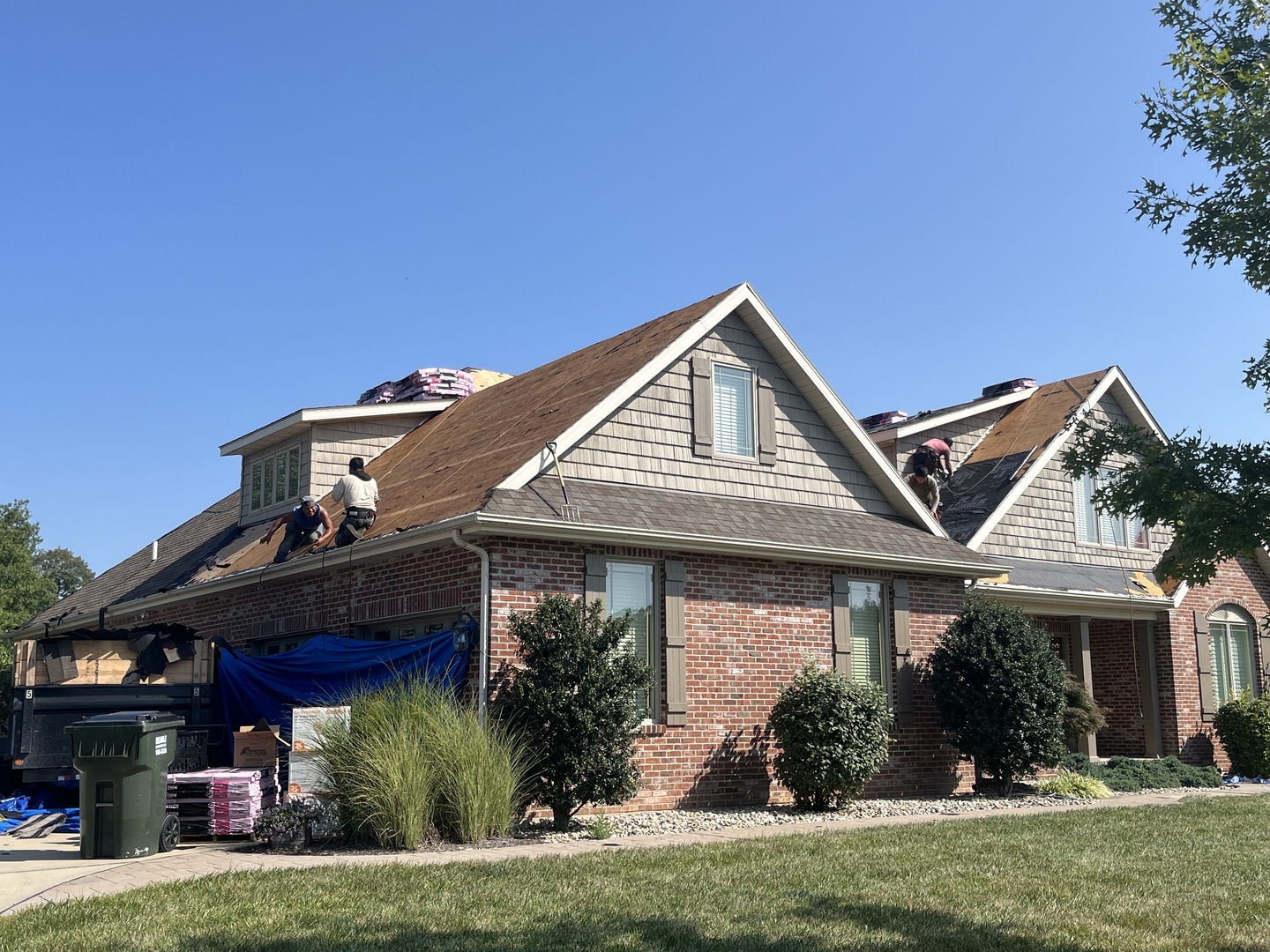
Roof Replacement Timeline: What to Expect in St. Louis
Updated August 26, 2026 | Lane House Roofing & Exteriors, St. Louis, MO
Direct Answer
A roof replacement in St. Louis takes one to three days of on-roof work for most homes. The full timeline runs two to six weeks, covering inspection, contract, permitting, material delivery, installation, and final inspection. Weather, roof complexity, and seasonal demand are the main variables.
TL;DR
- On-roof work takes 1 to 3 days for most St. Louis homes, and single-day installs are common
- The full calendar runs 2 to 6 weeks from first call to final walkthrough
- Permits are contractor-filed and typically approved in 1 to 3 business days across the metro
- Tear-off is the loudest stretch, roughly the first 3 to 4 hours of install day
- You can stay home the whole time; leaving is a comfort choice, not a requirement
- Weather moves install dates, and a rescheduled date is quality control at work
One liner: The roof takes days, the calendar takes weeks, and the noise takes one morning.
Key Numbers
| Figure | Value | Source |
| On-roof installation time, typical St. Louis home | 1 to 3 days | Local contractor consensus, 2026 [1] |
| Residential roofing permit turnaround, St. Louis metro | 1 to 3 business days | St. Louis permit guide, 2026 [2] |
| Full project timeline, first call to walkthrough | 2 to 6 weeks | Compiled from the stages below |
| Temperature where shingle sealant needs cold-weather technique | At or below 40F | Owens Corning technical bulletin [4] |
| Typical crew size on a residential replacement | 8 to 12 | Industry practice |
| Old material removed in a typical tear-off | Several thousand pounds | Industry practice |
How Long Does a Roof Replacement Take in St. Louis?
In short: Most St. Louis roof replacements take one to three days of on-roof work. The full process, from your first inspection call to the final walkthrough, usually runs two to six weeks.
Here’s the answer that surprises most homeowners: the roof itself is the fast part. For a typical St. Louis home between 1,800 and 2,800 square feet with a single layer of asphalt shingles, crews routinely finish the tear-off and installation in a single day [1] [5]. Larger homes, steeper pitches, and roofs with an extra shingle layer to remove stretch that to two or three days.
The calendar tells a different story. Before a single shingle comes off, you’ll schedule an inspection, review an estimate, sign a contract, pick materials, and wait for a permit and a material delivery date. In a quiet month, that can move in two weeks. During peak season, when every roofer in the metro is booked, it can take six weeks or more to get on the schedule.
| Roof type | Typical on-roof time |
| Single-story ranch, one layer, walkable pitch | 1 day |
| Two-story home, architectural shingles | 1 to 2 days |
| Steep pitch, dormers, or complex rooflines | 2 to 3 days |
| Standing-seam metal roof | 3 to 6 days [1] |
| Two-layer tear-off or decking repairs found | Add a day |
One more piece of good news for the planning side: permits rarely slow things down here. Most residential roofing permits in the St. Louis area are approved over the counter or online, often within one to three business days [2]. Your contractor handles that paperwork, not you.
So when you’re comparing estimates, listen for both numbers. A contractor should tell you how many days the crew needs on your roof and roughly when they can start. If either answer is vague, ask again.
The Full Roof Replacement Timeline, Start to Finish
In short: A St. Louis roof replacement moves through six stages: inspection, contract and material selection, permitting, material delivery, installation, and final inspection. Only one of those stages is loud.
Most timeline anxiety comes from not knowing what fills the weeks between signing and shingles. Here’s the whole calendar, stage by stage.
| Stage | Typical duration | What happens | What you do |
| 1. Inspection and estimate | 1 to 7 days to schedule; the visit takes about an hour | A roofer measures, photographs, checks decking from the attic if accessible, and writes a detailed scope | Ask questions, compare estimates |
| 2. Contract and materials | 1 to 3 days | You sign, pick your shingle line and color, and set expectations in writing | Choose in-stock lines if speed matters |
| 3. Permit | 1 to 3 business days in most metro jurisdictions [2] | Your contractor files with your municipality | Nothing; confirm it’s filed |
| 4. Material delivery | Scheduled 1 to 14 days out | Shingles arrive by boom truck, often loaded onto the roof; dumpster is dropped | Clear the driveway |
| 5. Installation | 1 to 3 days on the roof [1] | Tear-off, decking repair, underlayment, shingles, flashing, cleanup | Stay or go, your call |
| 6. Final inspection and walkthrough | Same week | Municipal inspection where required, contractor walkthrough, warranty registration | Walk the property, sign off |
The stretch that tests patience sits between stages 2 and 4. It isn’t stalling. Crews book in sequence, weather shuffles every job behind a rainout, and special-order shingle colors can add a week or two versus in-stock lines. A quiet gap with a firm install date is normal. A quiet gap with no dates at all is not.
That’s the difference worth insisting on. Before you sign, get three dates in writing: when the permit will be filed, when materials will be delivered, and when the crew starts. Any roofing company in St. Louis can commit to those milestones, weather permitting, and will tell you promptly when a storm forces a reshuffle.
One homeowner expectation worth resetting: a “three-week timeline” doesn’t mean three weeks of disruption. It means about nineteen quiet days of paperwork and waiting, one loud day or two of installation, and a walkthrough. The noise is concentrated; the calendar is not.
Before the Crew Arrives: Inspection, Permits, and Scheduling in St. Louis
In short: The pre-install weeks cover a thorough inspection, a permit your contractor files, material ordering, and a delivery drop. Your jobs are small: approve the scope, clear the driveway, and loop in your HOA early if you have one.
The inspection sets the whole timeline. A proper pre-replacement inspection takes about an hour, not ten minutes from the curb. Expect the inspector to measure the roof in squares (one square equals 100 square feet), photograph problem areas, check flashing at chimneys and walls, and look at the decking from inside the attic when there’s access. That attic check matters for your schedule: decking rot found now becomes a line item in the estimate. Decking rot found during tear-off becomes a mid-project change order and can add a day.
Permits are quick here, but they’re not optional. A full tear-off and replacement requires a permit in most metro jurisdictions, and approvals for standard residential re-roofs usually come over the counter or online within one to three business days [2]. Your contractor files it and posts it at the property. Two things trip people up. First, St. Louis City and St. Louis County are separate governments, and the county contains 88 municipalities, many with their own building departments, so the rules follow your exact address, not your zip code [2]. Second, if a contractor tells you a full replacement needs no permit at all, treat that as a warning sign, not a savings [2].
Scheduling is a queue, and the queue has seasons. Crews book jobs in sequence, and one rainout shuffles everything behind it. If your timeline is flexible, it’s worth knowing the best time of year for a roof replacement in this market, since late fall and winter openings often come faster than peak-season slots.
Delivery day is the dress rehearsal. A day or more before installation, a boom truck delivers shingles, often loading them directly onto the roof, and the dumpster or debris trailer lands in your driveway. Settle its location with your contractor beforehand, and mention sprinkler heads, septic components, or a driveway you’d rather protect with plywood.
One more early call: your HOA. Deed-restricted subdivisions across the metro require shingle color approval, and architectural committees can take weeks to respond. Send the color sample the week you sign, not the week the crew arrives.
How to Prepare Your Home for a New Roof: A St. Louis Homeowner’s Checklist
In short: Prep takes an evening, not a weekend. Cover what’s in the attic, take pictures off the walls, clear the driveway before 7 a.m., and plan for pets and work calls on the loud day.
Here’s the fact almost nobody warns you about: a roof replacement shakes your whole house. Every hammer strike and every bundle of shingles dropped on the deck travels through the framing. Homeowners regularly find a picture frame on the floor of a room two walls away from the work. Ten minutes with the checklist below prevents nearly all of it.
Inside the house
- Take down wall hangings, mirrors, and anything on floating shelves, especially upstairs
- Cover attic storage with old sheets or tarps; tear-off rains dust and grit through decking gaps onto everything below
- Move fragile items off high shelves and away from light fixtures that could rattle
- Plan for the noise if you work from home; a full day of hammering overhead defeats every mute button
Outside the house
- Move vehicles to the street by 6:30 to 7:00 a.m.; crews start early, and the driveway belongs to the dumpster and delivery
- Relocate patio furniture, grills, and potted plants away from the house perimeter
- Point out delicate landscaping near the drip line; crews tarp beds and lean plywood over shrubs, but they can’t protect what they don’t know you care about
- Unlock gates and share codes so the crew can reach every side of the house
- Note exterior outlet locations; compressors and nail guns need power
- If a satellite dish sits on the roof, it comes off and goes back on; expect to call your provider for realignment
People and pets
- Dogs and cats handle the vibration worse than the noise; a day at a friend’s house or daycare is kinder than a day of pacing
- Brief the kids: the yard is off limits during work hours, no exceptions, because debris and nails come down all day
- Tell your neighbors the date; they’ll appreciate moving their cars off the shared property line
None of this is heavy lifting. It’s one evening of moving small things and one early morning of moving cars. The crews handle the rest, including the tarps, the plywood shields, and the daily cleanup pass.
Roof Replacement Day: What Happens Hour by Hour
In short: Install day runs in a fixed order: tarp and tear-off in the morning, decking inspection at midday, then underlayment, shingles, flashing, and ridge work through the afternoon. On most St. Louis homes the whole sequence fits in one long day.
7:00 a.m.: Arrival and protection. The crew tarps landscaping, leans plywood over shrubs and windows near the drip line, and positions the dumpster path. Expect eight to twelve people on a residential job. Introductions happen fast because daylight is the budget.
7:30 to 11:00 a.m.: Tear-off. Crews work in teams with tear-off shovels, stripping shingles and old underlayment down to bare decking, one roof plane at a time. This is the loud stretch. From inside, it’s rhythmic scraping punctuated by thuds as debris slides to the dumpster. A typical tear-off sends a few thousand pounds of old material off your roof, which is why the dumpster owns the driveway.
11:00 a.m.: The decking inspection, the day’s one decision point. With the deck bare, the crew walks every sheet of plywood or OSB looking for rot, delamination, and soft spots. This is the only moment the timeline can change mid-project. Solid decking means the day proceeds on schedule. Damaged sheets get replaced first, which can add hours or, in bad cases, a day. A trustworthy crew photographs the damage, shows you, and confirms the per-sheet cost from your contract before cutting anything. If your estimate never mentioned a decking price per sheet, that conversation should have happened at the inspection stage.
11:30 a.m. to 3:00 p.m.: The dry-in and the shingle runs. The new roof goes on in layers, each with one job:
- Drip edge, metal along the roof’s perimeter that steers water into the gutters instead of behind them
- Ice and water shield, a self-sealing membrane at eaves, valleys, and penetrations; in a freeze-thaw climate like St. Louis, skipping it in valleys is one of the classic corners cut in lowball bids [3]
- Synthetic underlayment, the water-resistant layer covering the rest of the deck
- Starter strip and shingles, run from the eaves upward, nailed to the manufacturer’s pattern
- Step and chimney flashing plus pipe boots, sealing every place the roof meets something that isn’t roof
3:00 to 5:00 p.m.: Ridge vent, cap, and detail work. The ridge gets cut open or cleared for ventilation, the ridge vent goes on, and cap shingles finish the peak. Crews sweep the roof, pull the tarps, and start the ground cleanup, including the first magnetic sweep for nails.
By dinner, most single-day jobs are quiet again. If your roof runs to a second day, the crew dries in everything before leaving; an underlayment-covered deck sheds rain overnight without trouble.
Do You Need to Leave Home During a Roof Replacement?
In short: No. Most St. Louis homeowners stay home through the whole project, and the crew needs nothing from inside the house. Leaving is a comfort choice, not a requirement, and a few situations make it the kinder choice.
The crew works entirely outside. They bring their own power hookups, their own water, and their own lunch. You could sleep through the morning if the house allowed it, which, to be honest, it won’t.
So the real question is comfort. Here’s how the sound actually unfolds. Tear-off, roughly the first three to four hours, is the loudest stretch: scraping, thudding, and the frame-shaking vibration covered in the prep checklist. The afternoon shifts to nail guns, which are constant but rhythmic, more white noise than chaos once your ears adjust. The final two hours are mostly footsteps on the roof and cleanup in the yard.
A quick way to decide your plan:
- Stay and work around it. Fine for most people. Take calls in the basement or the room farthest from active tear-off, and expect to reschedule anything that requires silence before noon.
- Leave for the morning. The move for night-shift sleepers, sound-sensitive kids, and anyone with back-to-back video calls. By early afternoon the worst is over.
- Relocate for the day. Worth it for anxious dogs and cats, who read the vibration as a threat and pace for hours. A day of boarding or a friend’s spare room beats a day of panting. One St. Louis family we know scheduled the toddler’s nap during the crew’s lunch break, then decamped to grandma’s for the afternoon. Everyone won.
If you stay, two ground rules keep the day smooth. First, the yard and driveway are off limits during work hours, for everyone, because nails and debris come down all day; use the entrance farthest from active tear-off. Second, get the crew lead’s cell number during the morning introductions. Questions get answered in seconds at the gate instead of hours through the office.
And a small mercy worth knowing: crews want to finish as much as you want them finished. Nobody stretches a one-day roof into two on purpose. Daylight, weather, and the next job on the schedule all push the same direction you’re hoping for.
St. Louis Weather and Roof Replacement Delays: What Each Season Means
In short: Weather is the number one reason install dates move in St. Louis. Spring storms cause the most reschedules, summer heat shifts start times earlier, fall books up fastest, and winter installs work fine with cold-weather technique.
First, the reframe that saves you frustration: a moved install date is the quality bar working. Shingles can’t go onto a wet deck, and no responsible crew opens your roof with a storm cell on the radar. The contractor who reshuffles you for weather is protecting your decking. The one who pushes through is the one to worry about.
Here’s what each season typically means for your schedule:
| Season | The main risk | What it does to your timeline | The upside of booking it |
| Spring (Mar-May) | Thunderstorms and hail season | The most rainout reschedules; hail events flood the metro with insurance work and stretch every roofer’s calendar | Mild temperatures, ideal install conditions between systems |
| Summer (Jun-Aug) | Heat | Crews start at first light to beat afternoon heat on a shingle surface far hotter than the air; long days keep one-day jobs on track | Long daylight, fast dry-in, rare rainouts |
| Fall (Sep-Nov) | Demand, not weather | The busiest booking season as homeowners race winter; lead times from contract to install grow | The most reliable install weather of the year |
| Winter (Dec-Feb) | Cold | Fewer eligible days, but shorter queues mean faster scheduling | Often the quickest path from call to install |
The winter row deserves one honest paragraph, because “can you roof in winter” is a question with a myth attached. Asphalt shingles carry a factory-applied sealant strip that’s thermally activated: sun and warmth bond each shingle to the course below. At or below 40F, that sealant may not activate right away, so manufacturers like Owens Corning publish cold-weather procedures, including hand-sealing shingles with roof cement at edges and keeping bundles warm until they go up [4]. Installed with those precautions, a winter roof performs the same as a June roof. The sealant simply finishes bonding when warm sun returns.
One scheduling tactic pulled from the spring row: if your roof is aging but not leaking, replacing it in a quiet window beats waiting for the storm to decide your timeline. After a major hail event, every roofer in the metro is triaging insurance claims, and lead times stretch for everyone.
And if your replacement is storm-driven, plan for a longer runway. Insurance work runs on the claim’s clock before the roofing clock even starts: adjuster visits, scope approval, and supplements commonly add two to eight weeks depending on the claim [1]. The install itself still takes the same one to three days once approved.
Cleanup, Final Inspection, and Your Walkthrough: How the Job Should End
In short: A finished roof means a magnetic nail sweep of your whole yard, a hauled-away dumpster, a closed permit, registered warranties, and a walkthrough where you check the work before signing off.
The last hours of a roof replacement separate good contractors from great ones. The shingles are the same either way. The cleanup is not.
The cleanup standard. Crews should walk your property with rolling magnets, sweeping the lawn, flower beds, driveway, and sidewalks for nails, usually in multiple passes. Gutters get cleared of granules and tear-off debris, and downspouts go back exactly where they were. One tip worth using: ask for a final magnetic pass after the dumpster is hauled away. The pickup truck jostles the container, and stragglers can shake loose onto the driveway. Also ask the crew to leave a few spare shingles behind. A part-bundle in your garage means any future repair matches your roof’s exact color lot.
The official close-out. In jurisdictions that require it, a municipal inspector performs the final inspection and closes the permit. It’s a visual check, typically 20 to 45 minutes, verifying code items like nailing patterns, ice and water shield coverage at eaves and valleys, flashing at transitions, and ridge ventilation [2]. File that record with your home documents. It’s a small piece of paper that answers big questions later, for your insurer after a storm claim and for a buyer’s inspector when you sell.
Your walkthrough. Before you sign the completion paperwork, take fifteen minutes and check:
- Ridge lines run straight, with cap shingles evenly spaced
- Flashing sits tight at the chimney, walls, and pipe boots, with clean sealant lines
- Gutters are debris-free and downspouts reattached
- No nails in the driveway, lawn, or beds (run a shoe-level scan where kids and pets play)
- Vents and the satellite dish are back in place
- The attic shows no daylight through the deck when you look up on a bright day
Anything off goes on a punch list, and a reputable contractor fixes punch-list items promptly, not “when we’re back in the area.”
The paperwork that outlasts the crew. Two warranties should land in your inbox within days: the manufacturer’s material warranty, which your contractor registers for you, and the contractor’s own workmanship warranty covering the installation itself. If either arrives as a verbal promise instead of a document, ask again in writing.
And that’s the full arc, from first phone call to closed permit. If your St. Louis roof is showing its age and you want real dates instead of guesses, schedule a free inspection and estimate with Lane House Roofing & Exteriors. You’ll get a written scope, a materials plan, and the three dates that matter: permit, delivery, and install day.
Frequently Asked Questions
How many days does it take to replace a roof in St. Louis?
Most homes take one to three days of on-roof work, and single-day installs are common for typical single-layer asphalt roofs. Steep pitches, extra layers, and decking repairs add time. [1]
Do I need to leave home during a roof replacement?
No. The crew works entirely outside and needs nothing from inside the house. Some homeowners leave for the loud tear-off morning, and anxious pets do better spending the day elsewhere.
Do I need a permit to replace my roof in St. Louis?
In most metro jurisdictions, yes, a full tear-off and replacement requires a permit. Your contractor files it, and standard residential approvals usually take one to three business days. [2]
Can a roof be replaced in winter in St. Louis?
Yes. Below 40°F the factory sealant strip doesn’t activate right away, so crews follow manufacturer cold-weather procedures like hand-sealing. Installed that way, a winter roof performs like any other. [4]
Definition Bank
| Term | Plain-English definition |
| Tear-off | Removing the old shingles and underlayment down to the bare roof deck. |
| Decking (sheathing) | The plywood or OSB panels that form the roof’s structural surface. |
| Underlayment | The water-resistant layer installed between the decking and the shingles. |
| Ice and water shield | A self-sealing membrane at eaves, valleys, and penetrations that blocks wind-driven rain and ice damming. |
| Drip edge | Metal flashing at the roof’s perimeter that steers water into the gutters. |
| Flashing | Metal pieces that seal joints where the roof meets chimneys, walls, and pipes. |
| Ridge vent | An air outlet along the roof peak that lets the attic exhaust heat and moisture. |
| Square | The roofing unit of measure: 100 square feet of roof surface. |
Entity Cards
A typical St. Louis install day
| Property | Value |
| Crew arrival | 6:30 to 7:00 a.m. |
| Crew size | 8 to 12 |
| Loudest window | Tear-off, first 3 to 4 hours |
| The decision point | Midday decking inspection |
| Quiet again by | Dinner on single-day jobs |
The two warranties
| Property | Manufacturer warranty | Workmanship warranty |
| Issued by | Shingle manufacturer | Your contractor |
| Covers | Material defects | Installation quality |
| Arrives as | Registration confirmation | Written document |
Sources
- All Weather Roofing Systems, St. Louis Roofing Cost Guide 2026, updated April 2026. Project timeline table and insurance-work durations.
- Revolve Construction, St. Louis Roof Permit Guide: Cost, Process, Timeline, May 2026. Metro permit process, municipal breakdown, final inspection scope.
- Meridian Roofing and Renovation, Roof Replacement Cost St. Louis, May 2026. Common corner-cutting in below-market estimates.
- Owens Corning, Cold Weather Shingle Installation Technical Bulletin. Sealant activation at or below 40°F and hand-sealing procedure.
- Family First Exteriors, Complete Guide to Roof Replacement in St. Louis, 2023. Process-stage corroboration.